
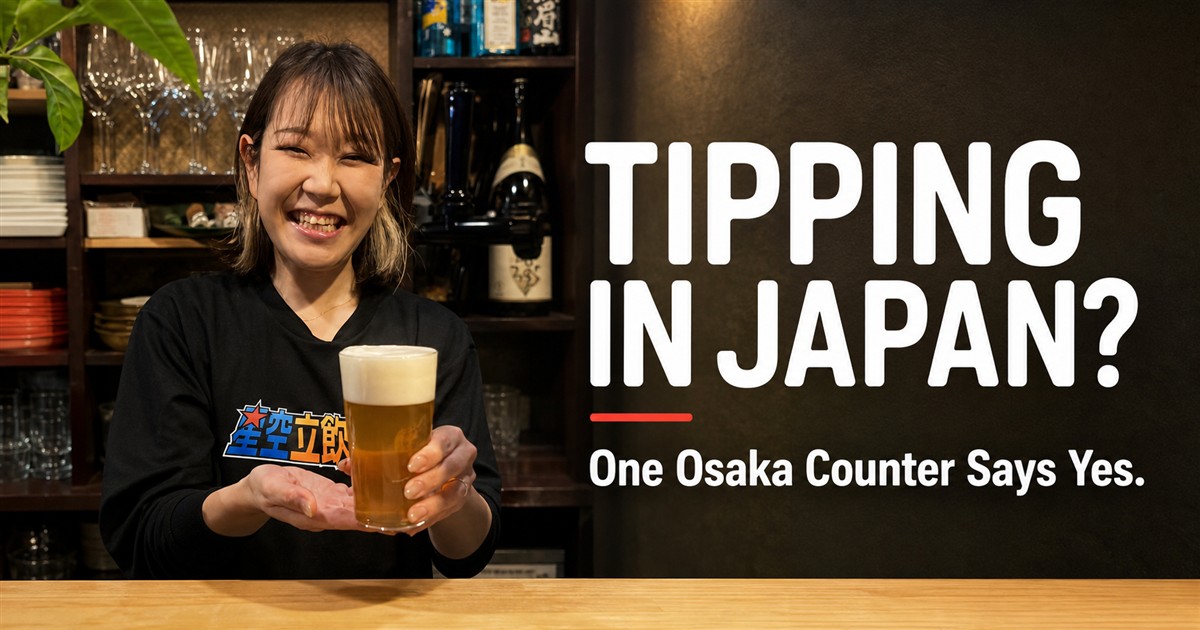
Hi! I’m the owner of Kaiebi (貝と海老そして蟹 / Shellfish, Shrimp & Crab), a 6-seat seafood counter in Shinsaibashi, Osaka.
If you’ve read any travel guide before coming to Japan, you’ve probably seen the rule: “Don’t tip in Japan.” And as general advice, honestly, it’s not wrong.
But our restaurant does things a little differently.
We run Kaiebi as a “model restaurant” for tipping in Japan. Tips here are welcome — and at the same time, completely, genuinely optional.
Let me explain why a small Japanese counter would choose to do that.
The usual rule: tipping isn’t expected in Japan
First, the standard etiquette, so there’s no confusion.
In most restaurants in Japan, tipping simply isn’t part of the culture. Good service is considered included in the price, and if you try to leave extra money on the table, many places will politely hand it back to you.
So travelers from tipping cultures sometimes tell us about an awkward moment they’ve had somewhere in Japan: the service was wonderful, they wanted to say thank you the way they would at home — and there was no way to do it.
That little moment is exactly where our story starts.
Why we welcome tips anyway
Kaiebi is a husband-and-wife counter with just 6 seats. I cook right in front of you, my wife Mizuki-chan keeps the room warm and friendly, and we get to hear your “that was delicious” face to face.
At some point I started thinking: when a guest feels “this time was special,” wouldn’t it be nice if there were a way to put that feeling into a visible form — separate from just paying the bill?
That’s what tipping is at our restaurant. The food is paid for by the bill. A tip is something else: a small, direct way of saying “you made my night,” delivered straight to the people in front of you.
I also believe tipping can be genuinely good for the people who work in restaurants — it builds motivation, confidence, and pride in service. Japan’s dining industry doesn’t really have this culture yet, so we decided to run our little counter as a model restaurant for it. If the idea spreads from a 6-seat shop in Shinsaibashi, even a little, I’d be thrilled.
How it works here (it’s very low-key)
There’s no tip jar staring at you from the counter, and nobody will mention tipping during your meal.
At the end, when you get the bill, you’ll also receive a small tip slip. If you’d like to tip, you just write in any amount you like, and it’s simply added to your bill — no fumbling for extra change, no handing over money awkwardly.
If you leave it blank, that’s completely fine. Truly.
“Do I have to tip?” — No. And that’s a promise.
I want to be very clear about this part.
Tipping at Kaiebi is never required, and nothing about your experience changes whether you tip or not. If you come in, enjoy the food, and walk out happy — that alone genuinely makes my day.
So please don’t feel any pressure. This isn’t a hidden service charge, and it isn’t an expectation. It’s just an open door, for the guests who want it.
The part nobody tells you: tipping feels good for the giver, too
Here’s something I’ve learned from watching guests use our tip slip.
Tipping isn’t only for the receiver. You decide the amount yourself, you attach it to a specific memory — “that one dish,” “that one conversation” — and you hand it, in effect, straight to the person standing in front of you.
Guests who do it often look a little pleased with themselves. Dinner stops being a simple transaction and becomes something closer to support — like backing a small team you’ve decided to root for.
And at a counter this small, we receive that feeling directly. It’s a straight line from your hands to ours.
For travelers: whichever type you are, you’re welcome
We’re lucky to welcome many guests from overseas at our counter.
If you’re from a tipping culture and you’ve missed being able to thank people that way in Japan — here’s one place where it won’t be refused.
If you’re relieved to be free of tipping for once — you’re just as welcome, and you can ignore the slip entirely with zero guilt.
Either way, come hungry. We have an English menu, and while our English isn’t perfect, we’ll meet you more than halfway with a smile. If you’re curious what to order, the story of why we serve live lobster at this counter is told in another article on this blog.
FAQ
Q. Is it rude to tip in Japan?
It’s generally not expected, and at many restaurants a tip may be politely declined. It’s rarely taken as an insult — just as something unfamiliar. At our restaurant, though, tips are openly welcomed as part of how we operate.
Q. How much should I tip at Kaiebi?
There’s no set amount and no expected percentage. Whatever feels right for you is right. Honestly, the feeling matters far more to us than the number.
Q. How do I actually tip here?
At checkout, you’ll receive a small tip slip with your bill. Write in any amount you like, and it’s paid together with the bill. No cash juggling needed.
Q. What happens if I don’t tip?
Absolutely nothing — and I mean that in the warmest way. Our service, our welcome, and our thank-you at the door are exactly the same.
—
Our philosophy, since the day we opened: “Through dining out, make life a little richer.”
If a night at our counter becomes one of those memories you come back to — what we like to call a thumbnail for your life — that’s the whole point of what we do.
Thank you for reading to the end!
—
Kaiebi (貝と海老そして蟹) — Shellfish, Shrimp & Crab
📍 2-7-11 Shinsaibashi-suji, Chuo-ku, Osaka (Nippo Royal Building 1F)
📞 06-6213-3881
🕐 12:00–17:00 (daytime, one reservation-only party per day) / 17:00–25:00 (last entry 22:30)
📅 Irregular holidays
💺 Counter seating for 6 (up to 8 for private bookings)