
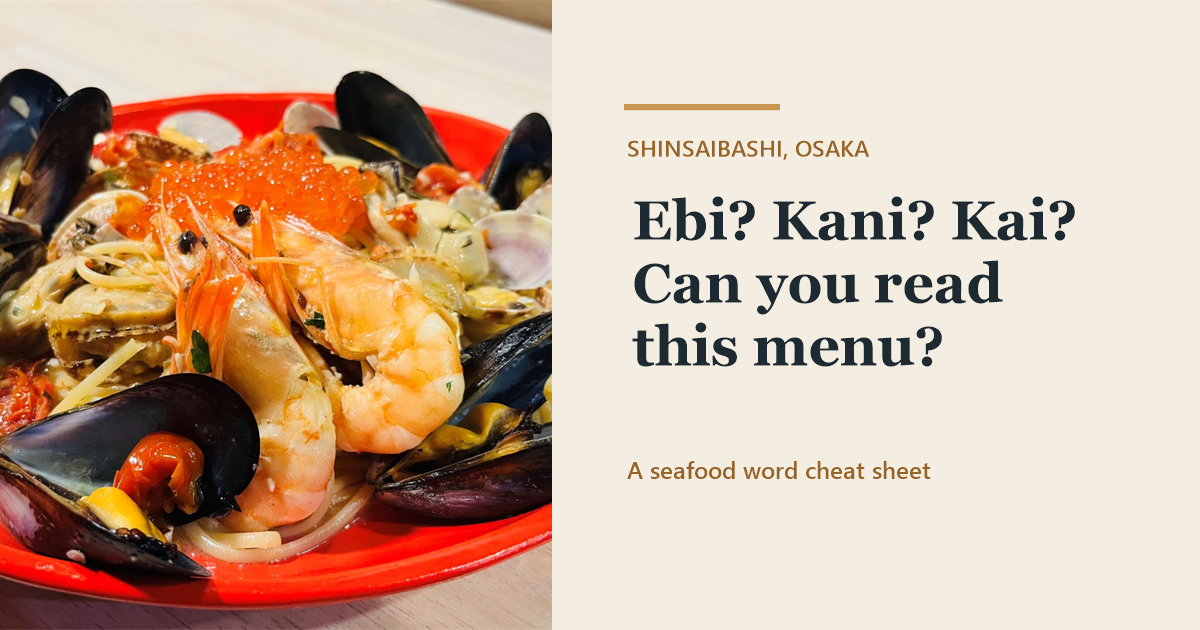
Hi! I’m the owner of Kaiebi (貝と海老そして蟹 / Shellfish, Shrimp & Crab), a 6-seat seafood counter in Shinsaibashi, Osaka. 🦐🦀
Here’s a fun fact: our restaurant’s name is already a little Japanese lesson.
– 貝 (kai) = shellfish
– 海老 (ebi) = shrimp / prawn
– 蟹 (kani) = crab
“Kai to ebi soshite kani” simply means “Shellfish, shrimp and crab.” That’s exactly what we cook. 😊
We do have an English menu, so you don’t need to memorize anything before you come. But knowing a few words makes eating in Japan much more fun — you’ll start recognizing them on menus, signs and food displays all over Osaka.
So today, here’s my little cheat sheet of Japanese seafood words, with the dishes you’ll find at our counter.
🐚 Kai (貝) — shellfish
Kai means shellfish in general — clams, oysters, scallops, mussels and more. Here are the words you’ll see most often:
– Kaki (牡蠣 / カキ) — oyster. “Nama-gaki” (生牡蠣) means raw oysters, and “kaki furai” (カキフライ) means fried oysters. We serve both. Here are five ways to enjoy oysters at our counter.
– Hotate (ホタテ) — scallop. We serve scallop sashimi (刺身, raw slices).
– Asari (あさり) — Manila clam (a small clam). Ours is an “asari no sakamushi” style dish — clams steamed with sake, served as a broth soup. *Sakamushi* (酒蒸し) means “steamed with sake.”
– Shijimi (しじみ) — a tiny freshwater clam famous for its deep, gentle broth. We use shijimi broth in our crab shabu-shabu.
– Mūru-gai (ムール貝) — mussel. Notice the “gai” at the end? When “kai” is joined to another word, it often changes to “gai.” Our mussels are cooked Naples-style with black pepper.
Tip: When you see 貝 in a dish name, you know shellfish is involved. 🐚
🦐 Ebi (海老) — shrimp, prawn and lobster
In Japanese, ebi covers everything from little shrimp to big prawns — and even lobsters. Japanese doesn’t really separate “shrimp” and “prawn” the way English does.
– Amaebi (甘海老) — “sweet shrimp.” *Ama* means sweet. We serve them as spicy fried amaebi (甘海老のスパイシー唐揚げ). *Karaage* (唐揚げ) means deep-fried.
– Tenshi no ebi (天使の海老) — literally “angel shrimp,” a prawn from New Caledonia (known as Blue Prawn). We serve it as sashimi with two condiments to compare — Sicilian sun-dried sea salt and Inoue Koshiki soy sauce. The texture is pleasantly chewy and bouncy (in Japanese we’d say *mocchiri*), and the heads are deep-fried so you can enjoy them too.
– Omāru ebi (オマール海老) — lobster (from the French *homard*). This is our signature: a live lobster from Canada, steamed with white wine and herbs in a Staub cast-iron pot. 🦞
– Ebi furai (海老フライ) — fried prawn in breadcrumbs. Ours has a very long name: *”Dekasugite agenabe ni hairanakatta tokudai tennen atama-tsuki ebi furai”* — “The extra-large wild prawn with head that was too big for our frying pot.” Yes, that really happened! Here’s the story behind that name.
– Ebi-mayo (エビマヨ) — prawns with a mayonnaise-based sauce, a popular dish in Japan. Ours is called *”Hitoaji chigau ebi-mayo”* — “Ebi-mayo with a little twist.”
Tip: You’ll sometimes see ebi written as 海老, sometimes as エビ or えび. They all mean the same thing. 🦐
🦀 Kani (蟹) — crab
– Kani (蟹 / カニ / かに) — crab. Like ebi, it can be written in three ways.
– Kani-miso (蟹味噌) — this one surprises a lot of visitors! It’s not miso paste. *Kani-miso* is the rich, creamy insides of the crab (the part that looks a bit like miso). We serve it as a fondue — dip bread and cheese into the kani-miso sauce.
– Kani-shabu (かにしゃぶ) — crab shabu-shabu: you swish crab through hot broth. Ours uses shijimi clam broth and finishes with zosui (rice porridge). You can read more about our crab shabu-shabu and kani-miso fondue.
– Watarigani (ワタリガニ) — blue crab (swimming crab). We make a blue crab pasta with fresh noodles from Kimotoya, a fresh pasta specialist.
– Kani-kurīmu korokke (カニクリームコロッケ) — crab cream croquette. A creamy, crispy Japanese favorite. On our menu, look for kanimi korokke (蟹身コロッケ).
🍚 A few more words you’ll see on seafood menus
– Sashimi (刺身) — sliced raw fish or seafood.
– Nama (生) — raw. (Fun fact: “nama” also means draft beer — *nama-biiru*! 🍺)
– Ikura (いくら) — salmon roe, those shiny orange pearls. We put it on our *kani ikura gohan* (rice with crab and salmon roe) and our special potato salad.
– Tamago (卵) — egg. We use Kinshi “Sekisairan” eggs from Kyotamba, Kyoto, in our fluffy *ebipei-yaki* and our TKG (*tamago kake gohan*, rice with raw egg).
– Furai (フライ) and karaage (唐揚げ) — two kinds of fried. *Furai* is breaded; *karaage* is usually coated in flour or starch.
– Shime (〆) — the dish that “closes” the meal, like ramen, pasta or rice. Here’s what shime means.
🗣 Five easy phrases for ordering
You can always point at the English menu — that works perfectly! But if you’d like to try a little Japanese, here are five easy phrases:
1. “Osusume wa nan desu ka?” — What do you recommend?
2. “Kore o kudasai.” — This one, please. (Point at the menu.)
3. “___ arerugī ga arimasu.” — I have a ___ allergy. For example: “Ebi to kani no arerugī ga arimasu” (I’m allergic to shrimp and crab).
4. “Oishii!” — Delicious! (The chef’s favorite word 😂)
5. “Okaikei onegaishimasu.” — The check, please.
If you have any allergies, please tell us before your visit if you can. If possible, we’ll use a substitute ingredient, but some dishes can’t be changed because of how they’re prepared. As a shellfish, shrimp and crab restaurant, please understand that most of our menu uses these ingredients.
Good to know before you visit
– Six counter seats only. It’s a small, calm place run by my wife and me, and it has been completely smoke-free since August 1, 2026.
– English menu available. My English isn’t perfect, but we’ll do our best to make you feel welcome.
– Location: about five minutes on foot from Shinsaibashi Station and from the Namba stations.
– Evening hours: 17:00–25:00 (until 1:00 a.m.), last entry 22:30. Holidays are irregular.
– Closed: all day on October 23 (Fri), 2026.
– Booking: a reservation is the surest way to get a seat. On the day, you can book online until 19:00; after that, please call 06-6213-3881 (from outside Japan: +81 6 6213 3881). If we don’t pick up right away, we may be busy cooking — please try again a little later. Here’s how to book a table without speaking Japanese.
FAQ
Q. What does “ebi” mean in Japanese?
Ebi (海老 / エビ) means shrimp or prawn. It’s also used for lobster, as in *omāru ebi* (オマール海老).
Q. What does “kani-miso” mean? Is it miso?
No — kani-miso (蟹味噌) is the rich, creamy insides of the crab, not miso paste. It’s often enjoyed with sake or wine.
Q. What is “kai” on a Japanese menu?
Kai (貝) means shellfish — oysters (*kaki*), scallops (*hotate*), clams (*asari*, *shijimi*) and mussels (*mūru-gai*).
Q. Do you have an English menu?
Yes, we do.
Q. How do I say I have a shellfish allergy in Japanese?
You can say “___ arerugī ga arimasu” (I have a ___ allergy). Please also tell us before your visit, so we can check what’s possible.
—
Our philosophy: “Through dining out, make life richer.”
Learning a few words is a small thing, but it can turn a meal into a conversation. If you come to our counter, try saying *”oishii!”* — it always makes my day. 🦞
Thank you for reading to the end!
—
Kaiebi (貝と海老そして蟹) — Shellfish, Shrimp & Crab
📍 2-7-11 Shinsaibashi-suji, Chuo-ku, Osaka (Nippo Royal Building 1F)
🗺 Google Maps
📞 06-6213-3881
🕐 12:00–17:00 (daytime, one reservation-only party per day) / 17:00–25:00 (last entry 22:30)
📅 Irregular holidays
💺 Counter seating for 6 (up to 8 for private bookings)