
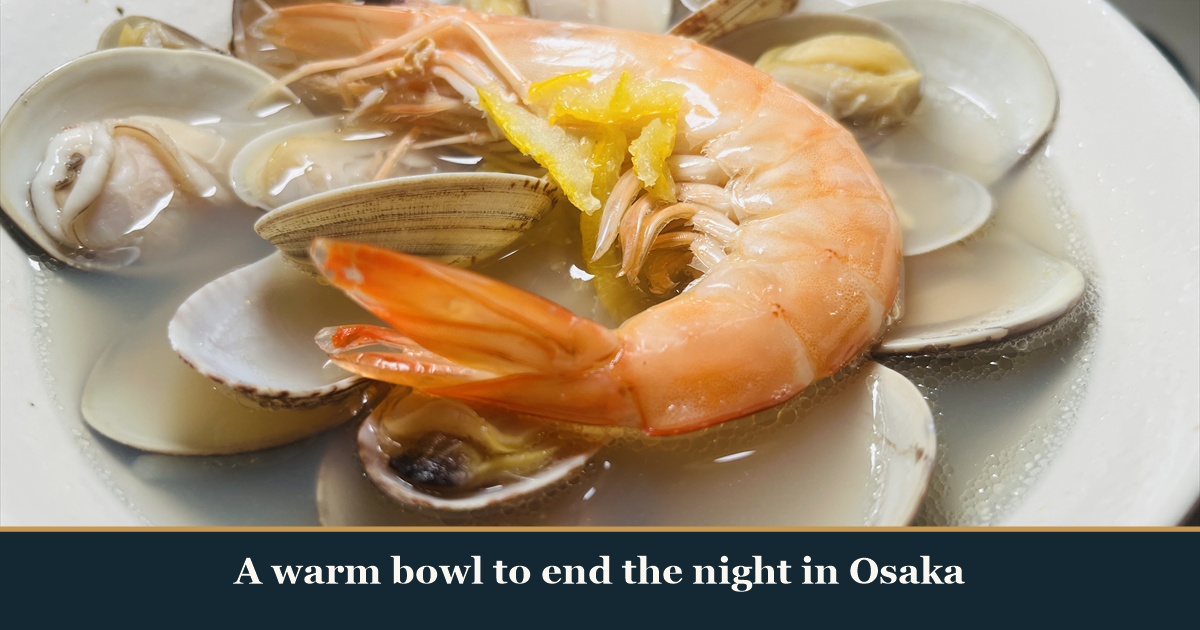
Hi! I’m the owner of Kaiebi (貝と海老そして蟹 / Shellfish, Shrimp & Crab), a 6-seat seafood counter in Shinsaibashi, Osaka. 🦐
If you’ve spent an evening eating and drinking in Japan, you may have noticed something: right at the end of the night, people often order one more dish. A bowl of ramen. A little rice. Some noodles.
That last dish has a name — “shime” (〆, pronounced “she-meh”).
Today I’d like to explain what shime is, and introduce the seven ways you can finish your night at our counter — without leaving your seat. 😊
What does “shime” mean?
“Shime” comes from the Japanese word *shimeru*, which means “to close” or “to tie up.” So shime is literally the dish that closes the meal.
In Japan, a typical night out goes something like this: drinks and small plates first, then a few bigger dishes, and finally a shime — usually something with rice or noodles to settle your stomach after drinking.
In big cities, it’s very common to leave the bar or izakaya and walk to a ramen shop just for the shime. In Osaka, you’ll see people doing exactly that late at night around Namba and Dotonbori.
On our menu, though, we have a whole page called “Shime-mon” (〆もん, “things for shime”). So you can enjoy your wine or sake, and finish the night in the same seat. 🍷
1. “Grand Shellfish Symphony” — a ramen made with shellfish broth
If you think “shime = ramen,” this is the one for you.
The name is a little dramatic (I know 😂), but Grand Shellfish Symphony is our ramen made with a shellfish broth. All that shellfish flavor goes into the soup.
After an evening of drinks, a warm, gentle shellfish soup is a very good way to end the night. If you love shellfish, please try it.
2. “Kanpo Curry” — a seafood curry with herbal ingredients
Some people like a little spice at the end of the night.
Our seafood curry, “Kanpo Curry,” is made with traditional Japanese herbal medicine ingredients from Yabuki Wakan Pharmacy, a herbal pharmacy in Midoribashi, Osaka.
Inside, you’ll find prawns, scallops and oysters, plus a marinated egg (*ajitama*) made with Kinshi “Sekisairan” eggs from Kyotamba, Kyoto.
3. Kaiebi-style Napolitan — a Japanese-born pasta
Have you heard of “Napolitan”? Despite the name, it’s not from Naples — it’s a Japanese-born pasta dish, traditionally made with a ketchup-based tomato sauce, and a classic of Japan’s Western-style home cooking (*yoshoku*).
Ours is made the Kaiebi way, with shellfish and prawns, using fresh noodles from Kimotoya, a fresh pasta specialist. If you still have some wine left in your glass, pasta is a nice way to finish it. 🍝
4. Blue crab pasta
We also have a blue crab (watarigani) pasta, using the same fresh noodles from Kimotoya.
If you want to enjoy crab right to the very end of your night, this is a good choice. 🦀
5. Tamago kake gohan (TKG) — rice with a raw egg
“Tamago kake gohan”, or TKG for short, is one of Japan’s simplest comfort foods: hot rice with a raw egg mixed in — usually with a little soy sauce.
We use Kinshi “Sekisairan” eggs from Kyotamba — the same eggs we use in our fluffy shrimp omelette dish (*ebipei-yaki*).
Raw egg can feel like a big step for some visitors, and that’s completely okay. But if you’re curious, this is a very Japanese way to end a meal. 🥚
6. EBI TKG — TKG with prawn
Want your TKG with a seafood twist? EBI TKG is our tamago kake gohan with prawn (“ebi” means prawn/shrimp in Japanese).
7. Kani ikura gohan — rice with crab and salmon roe
And for crab lovers: kani ikura gohan, rice topped with crab and ikura (salmon roe).
A small bowl of rice with crab and little bursts of ikura — a nice, gentle finish.
Bonus: if you order crab shabu-shabu, your shime is already included
Our crab shabu-shabu with shijimi clam broth comes with zosui at the end — a rice porridge cooked in the leftover broth. In Japan, finishing a hot pot with zosui or noodles is the classic shime.
You can read more about our crab shabu-shabu here.
How to choose your shime
Not sure which one to pick? Here’s my simple guide:
– Still have wine in your glass? → Napolitan or blue crab pasta
– Want to warm up with soup? → Grand Shellfish Symphony (shellfish ramen)
– Want a little spice? → Kanpo Curry
– Just a light bite of rice? → TKG or EBI TKG
– Crab until the very end? → Kani ikura gohan or blue crab pasta
If you’d like to share one dish between two people, or you’re not sure about the portion size, just ask me at the counter. 😊
What to drink before your shime
We have around 30 wines, all available by the glass, with a special focus on Japanese wine — including wine from my home region of Nagano. We also serve Japanese sake from my hometown brewery, Wakyo Shuzo.
Beer, lemon sour, highballs, shochu and soft drinks are available too. 🍶🍺
And if you’re wondering what to eat *before* the shime — our signature is the live lobster steamed with herbs, and we have plenty of shellfish too. Oysters are in season now; here are five ways to enjoy oysters at our counter.
We’re open late — so there’s time for shime
Our evening hours are 17:00–25:00 (until 1:00 a.m.), with last entry at 22:30.
So if you’ve been shopping in Shinsaibashi or walking around Dotonbori, you can still come in for a calm dinner, a few drinks and a shime to finish. (If that sounds like your kind of evening, you might also like my post about a quiet dinner after Dotonbori.)
Good to know before you visit
– Six counter seats only. It’s a small, calm place run by my wife and me, and it has been completely smoke-free since August 1, 2026.
– English menu available. My English isn’t perfect, but we’ll do our best to make you feel welcome.
– Location: about five minutes on foot from Shinsaibashi Station and from the Namba stations.
– Evening hours: 17:00–25:00, last entry 22:30. Holidays are irregular.
– Closed in October 2026: October 19 (Mon) evening, and all day on October 23 (Fri).
– Booking: a reservation is the surest way to get a seat. On the day, you can book online until 19:00; after that, please call 06-6213-3881 (from outside Japan: +81 6 6213 3881). If we don’t pick up right away, we may be busy cooking — please try again a little later. Here’s how to book a table without speaking Japanese.
– Allergies: please tell us before your visit. If possible, we’ll use a substitute ingredient, but some dishes can’t be changed because of how they’re prepared.
FAQ
Q. What is shime in Japan?
Shime (〆) is the dish that “closes” a meal or a night of drinking — usually ramen, noodles or rice. Many people in Japan like to finish their evening with one.
Q. What shime dishes do you have?
Grand Shellfish Symphony (ramen with shellfish broth), Kanpo Curry (seafood curry with herbal ingredients), Kaiebi-style Napolitan, blue crab pasta, tamago kake gohan (TKG), EBI TKG and kani ikura gohan (rice with crab and salmon roe).
Q. Does the crab shabu-shabu come with a shime?
Yes. Our crab shabu-shabu with shijimi clam broth comes with zosui (rice porridge) at the end.
Q. Can I come just for a late dinner?
Yes. We’re open until 25:00 (1:00 a.m.), and last entry is 22:30. A reservation is the surest way to get one of our six seats.
Q. Do you have an English menu?
Yes, we do.
—
Our philosophy: “Through dining out, make life richer.”
In Japan, how you end the night matters just as much as how you start it. I hope a warm bowl at our little counter becomes one of the good memories of your trip to Osaka. 🍜
Thank you for reading to the end!
—
Kaiebi (貝と海老そして蟹) — Shellfish, Shrimp & Crab
📍 2-7-11 Shinsaibashi-suji, Chuo-ku, Osaka (Nippo Royal Building 1F)
🗺 Google Maps
📞 06-6213-3881
🕐 12:00–17:00 (daytime, one reservation-only party per day) / 17:00–25:00 (last entry 22:30)
📅 Irregular holidays
💺 Counter seating for 6 (up to 8 for private bookings)