
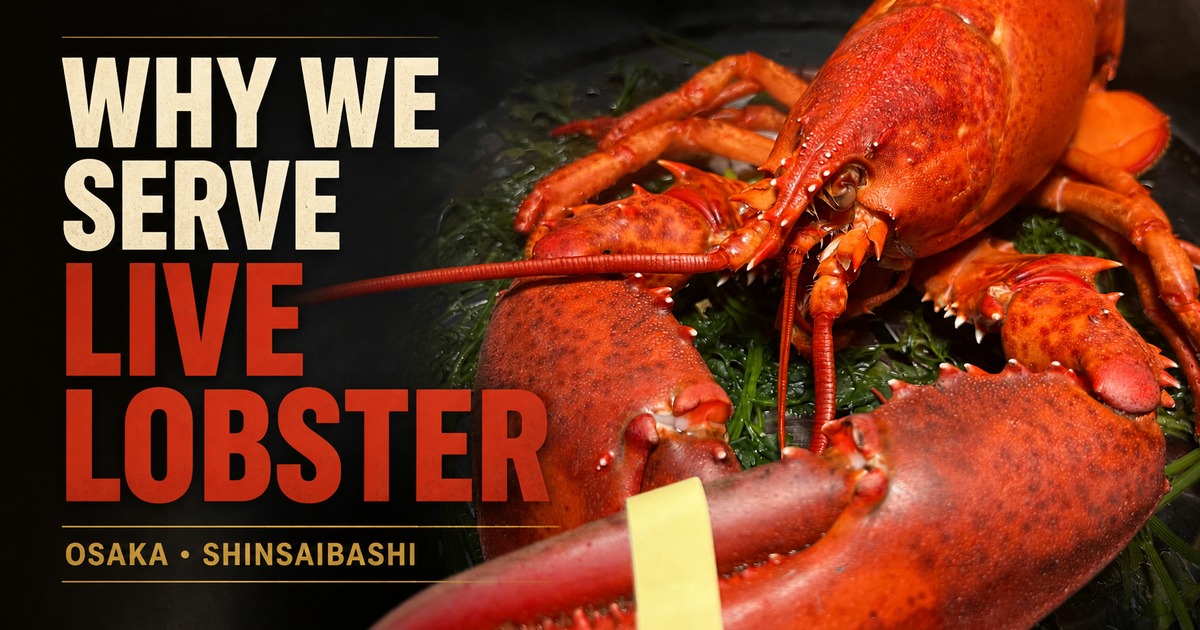
Hi, I’m the owner of Kaiebi (貝と海老そして蟹 / Shellfish, Shrimp & Crab) — a tiny 6-seat counter in Shinsaibashi, Osaka. People ask me the same question almost every week: “Why lobster? Why is a small Japanese seafood counter built entirely around live lobster?”
The honest answer starts in Italy, not Japan.
The lobster that changed how I think about food
Years ago, back in my training days, I visited Italy on a study trip — and in Venice, I ate live lobster for the first time. The taste was incredible, of course. But what I remember most isn’t the flavor — it’s the feeling. We were genuinely excited, like kids, watching it prepared right in front of us. That night wasn’t just a meal. It was a memory.
That’s the moment I decided: if I ever opened my own place, I wanted to bring that same excitement to Japan.
Why “just cooking” was never the goal
I could tell you our live lobster is steamed in a French Staub cast-iron pot with white wine and herbs, finished with French cultured butter, house-made lemon salt from domestic lemon peel, and a house-made pink tartar sauce. All of that is true, and I’m proud of it.
Why steaming? Because I honestly think it’s the best way to eat lobster. The meat comes out plump and bouncy, sealed with all its juices — delicious with nothing added at all.
But the technique was never really the point.
What I actually care about is the moment you meet it. You see your lobster alive first. Then, once it’s steamed, the pot comes straight to your seat and the lid comes off — steam rising, herbs filling the air, the moment everyone goes quiet for a second because it smells that good. That’s the part money can’t quite buy anywhere, and it’s the part I try to protect every single service.
We have a phrase we come back to a lot: “Through dining out, make life a little richer.” That’s not a slogan we picked for marketing. It’s genuinely why I still do this.
Why only 6 seats
We could have built a bigger restaurant. We didn’t.
With only 6 counter seats, I can actually watch how each lobster is doing and adjust as I go, instead of running a kitchen on autopilot. It also means you’re never far from the cooking — you’ll usually be the closest table in the restaurant, not the exception.
It’s a small space on purpose. Intimate, not fancy.
One lobster, shared
If it’s your first time, here’s the practical part: we usually recommend one lobster shared between two people. If you love lobster, or you just want to eat well, ordering one whole lobster per person is completely normal here too — plenty of guests do exactly that.
I’ll be honest, I don’t list a fixed price for it in this post, because what’s included can change depending on how you book. If that matters to you, just ask when you reserve — we’re happy to walk you through it.
The kind of nights we hope to be part of
Anniversaries. Birthdays. A dinner with someone who matters to you. A lot of our guests are celebrating something, and I love that.
We also have a phrase for that idea: a good night out becomes “a thumbnail for your life” — the one photo or memory you’ll come back to years later. If a plate of lobster at our little counter becomes that for even one table a night, that’s genuinely the whole point of doing this.
Come say hi
We also pour around 30 wines by the glass, with a strong focus on Japanese wine — a white wine is usually our first recommendation alongside the lobster, but ask us on the day and we’ll suggest something specific to what’s cooking.
If you’re planning a special night in Osaka, I’d love for the counter to be part of it.
—
Kaiebi (貝と海老そして蟹) — Shellfish, Shrimp & Crab
📍 2-7-11 Shinsaibashi-suji, Chuo-ku, Osaka (Nippo Royal Building 1F)
📞 06-6213-3881
🕐 12:00–17:00 (lunch, one reservation-only party per day) / 17:00–25:00 (last entry 22:30)
📅 Irregular holidays
💺 Counter seating for 6 (up to 8 for private bookings)